Does ashwagandha promote hair growth or reduce shedding? Online answers often combine three very different things: a serum applied to the scalp, one specific oral extract, and supplements containing numerous ingredients. Their findings are not interchangeable.
Since August 2026, a randomised trial has provided the first recent evidence on an oral ashwagandha extract and hair parameters. This is interesting, but it does not prove that any capsule treats alopecia. This guide separates what was actually tested, the studies’ limitations, and situations in which the cause of hair loss should be investigated first.
Short answer: interesting signals, not proof of guaranteed regrowth
A 2023 trial observed improvements with a topical serum containing ashwagandha root extract. A second trial, published in August 2026, studied a standardised oral extract for 75 days. Both reported favourable changes in selected hair measures versus placebo.
Certainty nevertheless remains limited: follow-up was short, the preparations were specific, and the extract supplier provided the study product in both trials. Independent teams need to reproduce the results in larger groups and across distinct hair-loss diagnoses.
The 2023 trial studied a serum, not a capsule
The 2023 double-blind randomised study enrolled adults aged 18–45 with mild to moderate hair loss; the per-protocol analysis included 61 people. For 75 days they applied either a topical ashwagandha root-extract serum or placebo. Researchers reported less shedding on a comb test and differences in density, growth and thickness measured with TrichoScan.
Route of administration matters. A serum contacts the scalp, whereas a capsule is digested and exposes the whole body. This study cannot promise the same result from an oral powder or capsule, nor justify making a homemade serum from a supplement.
What the 2026 oral trial adds
The trial published in Phytotherapy Research in August 2026 allocated adults aged 18–60 with hair loss or skin concerns to placebo or a standardised ashwagandha root extract. The studied preparation provided 300 mg twice daily for 75 days. The authors reported favourable differences in several TrichoScan measures, including density, growth and the proportion of hairs in anagen, as well as quality-of-life questionnaires.
This goes beyond a mere hypothesis, but it is still one short trial. The abstract cannot establish persistence after stopping, effectiveness across every cause of alopecia, or the benefit–risk balance over months or years. NCCIH specifically notes that safety beyond about three months is unknown.
Why these results do not apply to every capsule
The oral study concerns one species, plant part, extraction process, standardisation and amount. Two bottles simply labelled “ashwagandha” may contain root powder, a root-and-leaf extract, or very different withanolide levels. Matching milligrams do not establish equivalence.
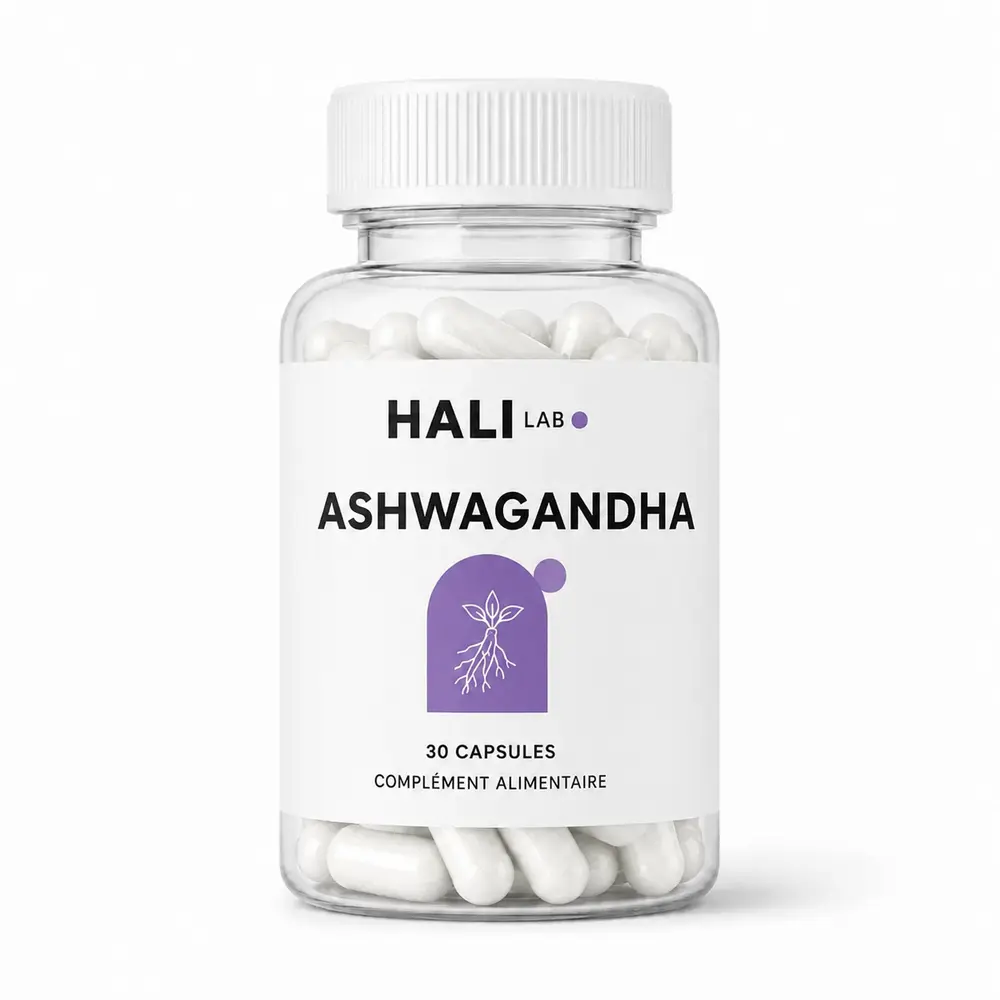
The capsule sold on this site is a food supplement, not a hair-loss treatment. Its label should be followed; a trial dose should not be copied unless it exactly matches the product. One positive study does not justify doubling intake or combining formulas.
Multi-ingredient supplements cannot prove an ashwagandha-only effect
A 2018 trial in 40 women with self-perceived thinning compared a proprietary supplement with placebo for six months. The product combined several botanicals and other ingredients. Hair differences were reported, but the design cannot identify any contribution from ashwagandha.
This distinction matters when advertising mentions “a clinical study” without showing the full formula. A result from a mixture does not validate each ingredient separately and cannot be transferred to a single-ingredient product.
Stress and reactive shedding: an association is not a treatment
The American Academy of Dermatology distinguishes excessive shedding, called telogen effluvium, from hair loss caused by interrupted growth. Major stress, high fever, surgery, childbirth, illness or substantial weight loss can be followed months later by diffuse shedding.
Even if some ashwagandha trials observed lower perceived stress, that does not show reversal of telogen effluvium. The chain “stress → cortisol → shedding → ashwagandha → regrowth” is an oversimplification. An improved stress score must be distinguished from a dermatological diagnosis and durable objective regrowth.
Shedding, breakage or alopecia: identify the problem first
Progressive thinning at the crown, distinct patches, diffuse shedding, fibre breakage and scalp inflammation do not have the same causes. Heredity, autoimmune disease, some medicines, tight hairstyles, harsh care, a documented deficiency or thyroid disease may require different approaches.
Seek prompt care for sudden patches, pain, redness, scarring, eyebrow loss, very heavy shedding or systemic symptoms. For persistent shedding, a dermatologist can distinguish loss from shedding, examine the scalp and decide whether tests are relevant. Delaying diagnosis while cycling through supplements can waste valuable time.
Grey hair, DHT and rapid growth: three unproven claims
The two specific trials do not show that ashwagandha restores the natural colour of grey hair. Nor do they prove clinically useful DHT blocking in humans or visibly faster growth within days. Each claim would require a trial designed for that outcome.
Before-and-after photos without a protocol, matched lighting, magnification and control group are insufficient. Comparing a product with the 2026 study requires checking at minimum Withania somnifera species, root, extract type, standardisation, dose and duration—while retaining caution because independent replication is absent.
Before oral use: check the precautions
According to NCCIH, ashwagandha can cause drowsiness, stomach upset, diarrhoea or vomiting, and rare liver injuries have been reported. It is not advised during pregnancy or breastfeeding, before surgery, or with certain thyroid or autoimmune disorders. Interactions may occur with sedatives, immunosuppressants, thyroid medicines, and drugs for diabetes or blood pressure.
If hair loss is your main concern, immediately adding a capsule may not be the most useful first step. Record when it started, how it changed, events two to four months earlier and products already used. This timeline is more helpful for diagnosis. This content is educational and does not replace professional medical advice. Seek medical advice before supplementation if symptoms persist, during pregnancy or breastfeeding, or when taking medication or living with a chronic condition.
Frequently asked questions
Does ashwagandha really grow hair?
Two short trials reported favourable differences with one topical serum and one specific oral extract. They do not prove guaranteed regrowth, treatment of every alopecia, or efficacy of all capsules.
Can a capsule be opened and applied to the scalp?
Not recommended. The studied topical formula was a serum designed for that use. Oral powder may contain excipients, lacks the same vehicle, and has not been tested for skin tolerability.
Does ashwagandha reduce stress-related shedding?
Stress can precede telogen effluvium, but improved stress does not prove treatment of that shedding. The cause should be confirmed, especially if loss persists or other signs occur.
How long before a hair effect can be seen?
The specific trials lasted 75 days, which does not guarantee an individual result by then. Hair cycling is slow and diagnosis-dependent. Be wary of promises within a few days.
Can ashwagandha prevent grey hair?
Available trials show neither prevention of greying nor restoration of natural colour. Arguments based only on stress, antioxidants or traditional use remain indirect.
Educational content: this is not a diagnosis or prescription and does not replace professional healthcare advice.