“What dose of ashwagandha should I take?” is a common question, but an isolated number is not enough. An amount of root powder cannot be compared directly with the same amount of an extract, and two extracts may differ in plant part, process and withanolide content. Trials have also studied different goals, populations and durations.
This guide does not prescribe a dose. It explains how to interpret milligrams, the daily serving and course duration, then places study quantities in context. The aim is to prevent two common errors: copying a trial dose without having the same product, or assuming that a higher amount guarantees a better result.
Short answer: there is no validated universal dose
The NIH Office of Dietary Supplements considers a precise recommendation difficult because studies use very different preparations and doses. In stress trials reviewed by NIH, extract amounts ranged from 240 to 1,250 mg per day, while one study used granules equivalent to several grams of root powder. These numbers therefore do not describe the same product.
A studied quantity is not automatically a recommended dose. It belongs to a protocol with eligibility criteria, a formulation, placebo and monitoring. The right question is not only “how many milligrams?” but “of which preparation, per serving, for whom and for how long?”
Powder and extract: milligrams are not interchangeable
Powder is generally dried and ground plant material. An extract is made by removing and concentrating selected soluble constituents. Therefore, 300 mg of powder and 300 mg of extract do not represent the same material. Even a stated 10:1 ratio cannot establish clinical equivalence because yield and retained compounds depend on the process.
Standardisation adds another piece of information. For example, 300 mg of an extract declared at 5% mathematically equals 15 mg of declared markers. This calculation verifies neither actual content nor efficacy. It only helps read the label and cannot transfer a standardised-extract dose to powder or another extract.
Stress: what trial quantities actually mean
Stress trials illustrate the difficulty. A 2019 study tested one specific extract at 240 mg daily for 60 days. Other protocols used 300 mg daily in sustained-release form, 225 or 400 mg daily, or 300 mg twice daily. A result from one product does not prove that another preparation will have the same effect at the same amount.
NIH notes that some trials found larger effects with 500 to 600 mg of extract daily than with lower amounts. This does not create a “more is better” rule: comparisons did not always use the same extract, sample sizes were modest and a higher dose may also increase adverse effects.
Sleep: 120 mg and 600 mg may describe very different extracts
In one sleep trial, participants received 120 mg daily of a highly standardised root-and-leaf extract for six weeks. Another trial used 600 mg daily of a root extract for eight weeks. Comparing only 120 with 600 suggests that the second is five times “stronger,” even though preparations and declared contents differed.
The review cited by NIH reports a small overall sleep effect and more visible findings in some subgroups, particularly people with insomnia and protocols lasting at least eight weeks. It cannot determine an ideal amount for an individual or make ashwagandha a substitute for insomnia care.
Course duration: evidence mainly covers a few weeks
Most stress or sleep trials lasted about six to twelve weeks. NIH and NCCIH state that ashwagandha appears generally well tolerated for use up to about three months, but safety over many months or years is unknown. A “three-month course” does not mean automatic three-month use is necessary or suitable for everyone.
A course should have a clear goal, reassessment date and stopping criteria. Continuing because the bottle is unfinished or increasing the amount because no effect is felt after a few days is not trial-based practice. If a symptom persists, its cause should be investigated rather than extending supplementation indefinitely.
One capsule, one serving and a daily amount are different
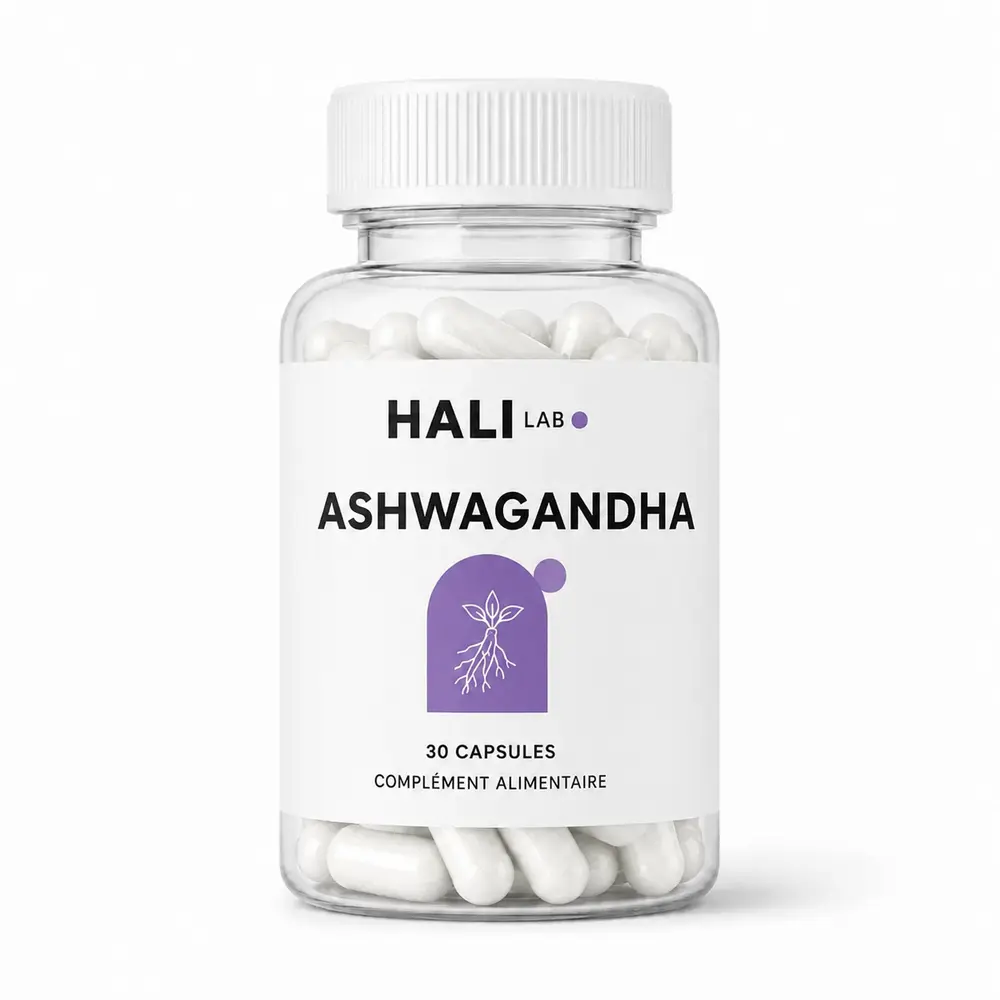
A front label may state “600 mg” while the panel shows that this amount corresponds to two capsules. Conversely, one capsule may contain several ingredients, only part of which is ashwagandha. Check serving size, servings per bottle, ashwagandha amount per serving and the full active-ingredient list.
Also check plant part, extract type and withanolide percentage if declared. A “herb equivalent” statement should not be confused with the actual extract weight. The powder-versus-extract guide explains these details and supports product-by-product comparison.
Starting, increasing or missing a serving: avoid improvisation
A website cannot define an individual progression without knowing age, conditions, medicines and the exact product. Follow the label when the product is appropriate, and ask a pharmacist or doctor if you take treatment or are unsure. Do not double a missed serving or combine multiple ashwagandha supplements to reach an online number.
Drowsiness, nausea, loose stools and stomach discomfort are reported effects. A higher amount is not an automatic solution to lack of effect and may worsen tolerability. Stop and seek advice if an unusual symptom appears; seek prompt assessment for jaundice, dark urine, widespread itching or significant abdominal pain.
Who should not choose an ashwagandha dose alone?
NCCIH advises against ashwagandha during pregnancy and breastfeeding, before surgery, and with thyroid or autoimmune disorders. It may interact with thyroid hormones, immunosuppressants, sedatives, anticonvulsants and some diabetes or blood-pressure medicines.
People with liver disease, hormone-sensitive prostate cancer, chronic illness or multiple medicines should obtain medical review before use. For children or adolescents, available evidence does not support deriving a dose from adult trials.
This content is educational and does not replace professional medical advice. Seek medical advice before supplementation if symptoms persist, during pregnancy or breastfeeding, or when taking medication or living with a chronic condition.
Frequently asked questions
What is the recommended daily ashwagandha dose?
There is no universal amount for every powder, extract and person. Trials use varied preparations; follow the label of an appropriate product and seek advice when taking medicines or living with illness.
Is 600 mg of ashwagandha more effective than 300 mg?
Not necessarily. Without knowing powder versus extract, plant part, standardisation and serving size, the numbers are not comparable. A higher amount may also be less well tolerated.
How long does an ashwagandha course last?
Trials mainly last six to twelve weeks and tolerability data generally extend to about three months. Safety over many months or years is not established; plan reassessment rather than indefinite use.
Can the dose be increased if there is no effect?
Do not increase it automatically. First review the product, serving, duration, tolerability and cause of the symptom with a professional. Lack of effect does not show that the amount is insufficient.
What should I do if I miss a serving?
Do not double the next serving. Check the product instructions or ask a pharmacist, especially when ashwagandha is part of a formula containing other active ingredients.
Educational content: this is not a diagnosis or prescription and does not replace professional healthcare advice.
Sources
- NIH Office of Dietary Supplements — efficacité, doses étudiées et sécurité
- NCCIH — Ashwagandha : utilité, sécurité et interactions
- Lopresti et al. — essai randomisé sur le stress, 240 mg/jour (2019)
- Deshpande et al. — essai randomisé sur le sommeil (2020)
- Langade et al. — essai randomisé sur l’insomnie et l’anxiété (2019)
- Verma et al. — essai de tolérance chez des volontaires sains (2021)
- Björnsson et al. — série de cas de lésions hépatiques (2020)