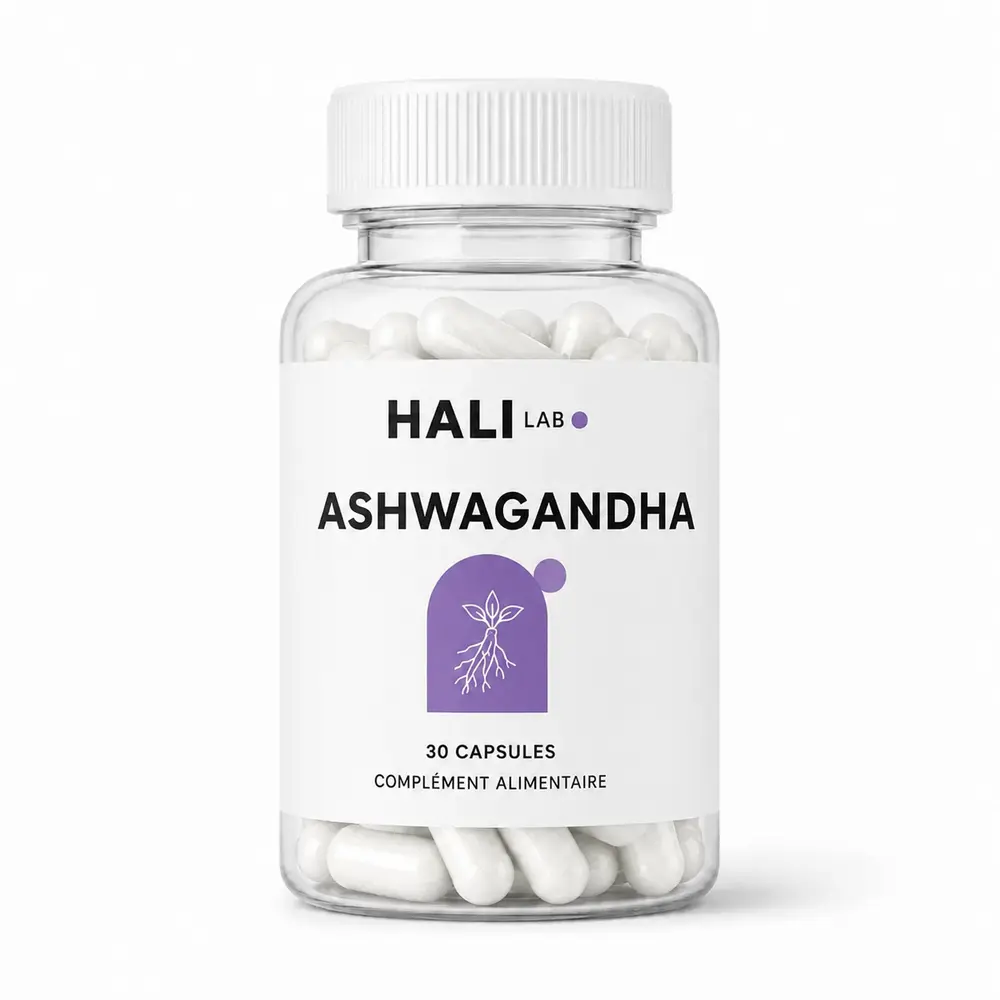
“Powder or capsules?” sounds like a simple question, but it mixes two different pieces of information. Powder describes material prepared from the plant; a capsule only describes the container. An ashwagandha capsule may therefore hold root powder, a dry extract, a root-and-leaf blend or several ingredients.
This guide helps consumers in Morocco decode a label before buying: plant part, preparation type, amount per serving, withanolide standardisation and the full ingredient list. It does not rank one form as automatically better. Studies use very different preparations, and recent analyses show that the measured composition of some commercial products may differ from their labels.
Short answer: a capsule is not a type of extract
A powder is generally a dried plant part that has been ground. An extract is made by contacting plant material with a liquid to remove selected constituents; it may then be concentrated and dried. According to the NIH Office of Dietary Supplements, a dry extract can be used to make capsules or tablets. “Extract” and “capsule” are therefore not opposing options.
To know what you are buying, look for wording such as “root powder,” “dry root extract” or “root-and-leaf extract.” If the front only says “ashwagandha capsules,” turn the bottle around: the ingredient list and per-serving panel are more informative than the slogan.
Plant powder: simple to identify, but not chemically uniform
Powder retains a plant matrix closer to the starting material. That does not mean every batch contains exactly the same proportions of compounds. Species, harvested part, origin, season, drying, storage and analytical methods can change the chemical profile. Milligrams of powder alone therefore do not specify an exact withanolide amount.
Powder is not automatically “more natural,” gentler or safer than an extract. Those words lack a sufficient clinical definition for making a choice. Safety also depends on the person, amount used, other ingredients, medicines and the product’s actual quality.
Extract: a concentrated preparation, not an efficacy promise
Extraction selects and concentrates some soluble constituents according to the process used. Two ashwagandha extracts are not necessarily equivalent: plant part, solvent, plant-to-extract ratio, standardisation and marker-testing method may differ. The word “extract” without further detail is incomplete.
A more concentrated extract is not automatically more effective because trials assess a specific preparation, population and duration. A result from one studied extract cannot be transferred to every bottle bearing the same plant name. NCCIH specifically notes that ashwagandha studies use varied preparations and doses.
Root, leaves or a blend: a detail that matters
Ashwagandha does not have the same chemical profile in every tissue. A phytochemical study in Scientific Reports observed different distributions of withanolides between roots and leaves. This makes the plant part worth checking, but does not show that root or leaf is always superior.
Naming the plant part also makes comparison with a study or monograph easier. If the label says neither root nor leaf, useful information is missing. A root-and-leaf blend is not necessarily poor; it should simply be declared clearly so it is not mistaken for a root-only product.
Withanolides and standardisation: how to read the percentage
Withanolides are a family of compounds used as markers in ashwagandha analysis. “Standardised to 5%” normally means the manufacturer targets a defined content under its process and testing method. Standardisation aims for more consistent batches; alone, it does not prove full identity, absence of contaminants, bioavailability or clinical benefit.
To calculate the declared marker amount, you need the extract amount per serving. For example, 300 mg of an extract declared at 5% mathematically equals 15 mg of declared markers. This calculation recommends no dose and does not verify the product; it only holds if the amount, percentage and stated method are accurate.
Why the same “5%” does not make two products identical
A percentage describes neither the total daily amount, the detailed profile of individual withanolides nor the plant part. It may not show whether the value applies to one capsule or several. To compare properly, align serving size, extract amount, plant part and standardisation method rather than only the large front-label number.
A plant-to-extract ratio, sometimes written 10:1, describes a manufacturing relationship but cannot reconstruct every compound in the finished product. It should not be multiplied mechanically to claim that a capsule “equals” a large clinical powder dose. Equivalence depends on process, yield and what was actually measured.
What commercial-product testing has found
A 2025 analytical study examined 21 capsule products and one root-powder sample using chromatography and mass spectrometry. Researchers found substantial product-to-product variation and, in several tested samples, gaps between declared values and measured constituents. The study only describes the products analysed; it does not show that every ashwagandha supplement is mislabelled.
Another comparison published in 2025 assessed commercial samples against British and US pharmacopoeial methods. It reinforces the value of botanical identification and transparent analytical methods. For buyers, the right response is not to chase the highest percentage, but to prefer a complete label, traceable batch and identifiable responsible business.
Buying checklist in Morocco: eight details to verify
Before buying, check: 1) the botanical name Withania somnifera; 2) plant part; 3) powder or extract; 4) amount per capsule and serving; 5) standardisation and unit if declared; 6) full excipient and active-ingredient list; 7) batch number and expiry date; 8) the manufacturer, importer or responsible seller’s name and contact details.
Be cautious with “maximum strength,” “premium quality” or “superior absorption” when no method, batch certificate or relevant clinical comparison supports them. A QR code or attractive packaging does not replace this information. Keep a label photo when asking a pharmacist or doctor for advice.
Safety: dosage form does not remove contraindications
Powder, extracts and capsules share ashwagandha precautions. NCCIH advises against use during pregnancy and breastfeeding, before surgery, and with autoimmune or thyroid disorders. Interactions may occur with diabetes or blood-pressure medicines, immunosuppressants, sedatives, anticonvulsants and thyroid hormones.
NCCIH also reports rare cases of liver injury associated with ashwagandha supplements. Stop the product and seek prompt assessment for jaundice, dark urine, widespread itching, unusual abdominal pain or marked fatigue. Do not choose a personal dose from a percentage calculation or a trial dose.
This content is educational and does not replace professional medical advice. Seek medical advice before supplementation if symptoms persist, during pregnancy or breastfeeding, or when taking medication or living with a chronic condition.
Frequently asked questions
Are ashwagandha capsules more effective than powder?
That cannot be concluded. A capsule is a container that may hold powder or extract. Any potential effect depends on the studied preparation, not the container alone.
Is a 5% withanolide extract necessarily better?
No. Percentage alone does not prove identity, purity, amount per serving, bioavailability, safety or clinical effectiveness.
How do you convert a withanolide percentage into milligrams?
Multiply the extract amount by the declared percentage: 300 mg at 5% gives 15 mg declared. This is label arithmetic, not a dosage recommendation or laboratory verification.
Should you choose root rather than leaves?
Their chemical profiles differ, but that does not establish universal superiority. The plant part should be clearly declared and match the evidence to which the product refers.
What should I check on an ashwagandha label in Morocco?
Check the botanical name, plant part, powder or extract, amount per serving, any standardisation, every ingredient, batch, date and the responsible business’s identity.
Educational content: this is not a diagnosis or prescription and does not replace professional healthcare advice.
Sources
- NCCIH — Ashwagandha : utilité, sécurité et diversité des préparations
- NIH Office of Dietary Supplements — définitions des poudres, extraits et de la standardisation
- Zellner et al. — analyse de 21 produits commerciaux d’ashwagandha (2025)
- Avula et al. — comparaison des méthodes pharmacopéiques et d’échantillons commerciaux (2025)
- Gupta et al. — profils phytochimiques distincts des racines et feuilles (2015)