KSM-66, Sensoril and Shoden are trade names for ashwagandha extracts, not three different botanical varieties. Each preparation has its own raw material, extraction process, standardisation and studies. A milligram amount or withanolide percentage is therefore not enough to identify a “best” product.
This guide compares verifiable information: plant part, amount actually studied, trial duration and population. To date, the cited trials have not directly compared all three extracts within one protocol. An absolute ranking would therefore be an extrapolation, not a scientific conclusion.
Short answer: no proven winner from a direct comparison
The NIH notes that ashwagandha studies use different preparations, standardisation processes and doses. This heterogeneity makes it difficult to identify one specific extract or recommended amount. A result obtained with KSM-66, Sensoril or Shoden first describes the tested preparation, population and protocol duration.
Changes reported in separate trials cannot be compared as if participants had been randomised between two brands. Eligibility criteria, questionnaires, lifestyles and statistical methods differ. Choice should therefore begin with a transparent label and a need discussed with a professional, not a marketing league table.
An extract brand is neither a botanical variety nor a universal guarantee
The plant remains Withania somnifera. A patented or trademarked name identifies a manufacturer’s preparation intended to be reproduced to a specification. It can help trace a trial to an ingredient, but it does not prove that every finished product carrying that name has the same overall quality.
The finished formula also matters: amount per serving, excipients, other actives, storage, batch, expiry and manufacturer testing. A shop or advert saying only “KSM-66 type” or “Sensoril equivalent” does not demonstrate use of the authentic ingredient. The exact name should appear on the label or in verifiable documentation.
KSM-66: a root extract studied at its own doses
In the NIH summary, KSM-66 is listed among extracts made from root alone. A randomised sleep trial used two 300 mg capsules daily, or 600 mg per day, for eight weeks. It included 80 adults, half with insomnia, and assessed sleep-onset latency, sleep efficiency and validated questionnaires.
This protocol does not mean that 600 mg suits everyone or that a generic 600 mg root extract will reproduce the result. Nor can it show KSM-66 is superior to a root-and-leaf extract, because the trial included no Sensoril or Shoden group.
Sensoril: root and leaf, tested at several amounts
Recent research describes Sensoril as a standardised aqueous root-and-leaf extract. A 2024 randomised trial studied 125, 250 and 500 mg daily for eight weeks in adults reporting mild-to-moderate chronic stress. Of 131 people enrolled, 98 were included in the final analysis.
The study reported changes in stress measures, but it did not compare Sensoril with KSM-66 or Shoden. It concerned one preparation and context. Repeating only “effective from 125 mg” without composition, population, duration and limitations turns a research result into a slogan.
Shoden: another root-and-leaf extract that should not be confused
Shoden is also a root-and-leaf extract, but it is not Sensoril under another name. In a randomised sleep trial, 150 adults with self-reported sleep problems received 120 mg per day for six weeks. NIH notes that the two 60 mg capsules together supplied a preparation highly standardised in withanolide glycosides.
Another 2019 trial studied 240 mg of Shoden once daily for 60 days in 60 stressed adults. These two trials do not establish a universal dose and cannot transfer their results to powder, an unidentified extract or a multi-ingredient formula.
Why 120 mg, 240 mg and 600 mg do not measure “strength”
Milligrams state the mass of an extract, not its complete composition. A smaller amount may be more concentrated in declared markers, but a higher percentage guarantees neither better absorption nor a larger clinical effect. Analytical methods may also target total withanolides, selected glycosides or other compound groups.
A proper comparison combines at least four elements: mass per daily serving, plant part, standardisation type and the exact preparation studied. Even that table cannot replace a direct comparison trial. Its main value is avoiding the error that more milligrams must mean better.
A practical buying checklist for Morocco
On the bottle or box, look for the botanical name, root or root-and-leaf wording, the exact extract name if claimed, amount per capsule and daily serving, standardisation type, full ingredient list, batch and expiry. Also check the responsible operator’s contact details and storage instructions.
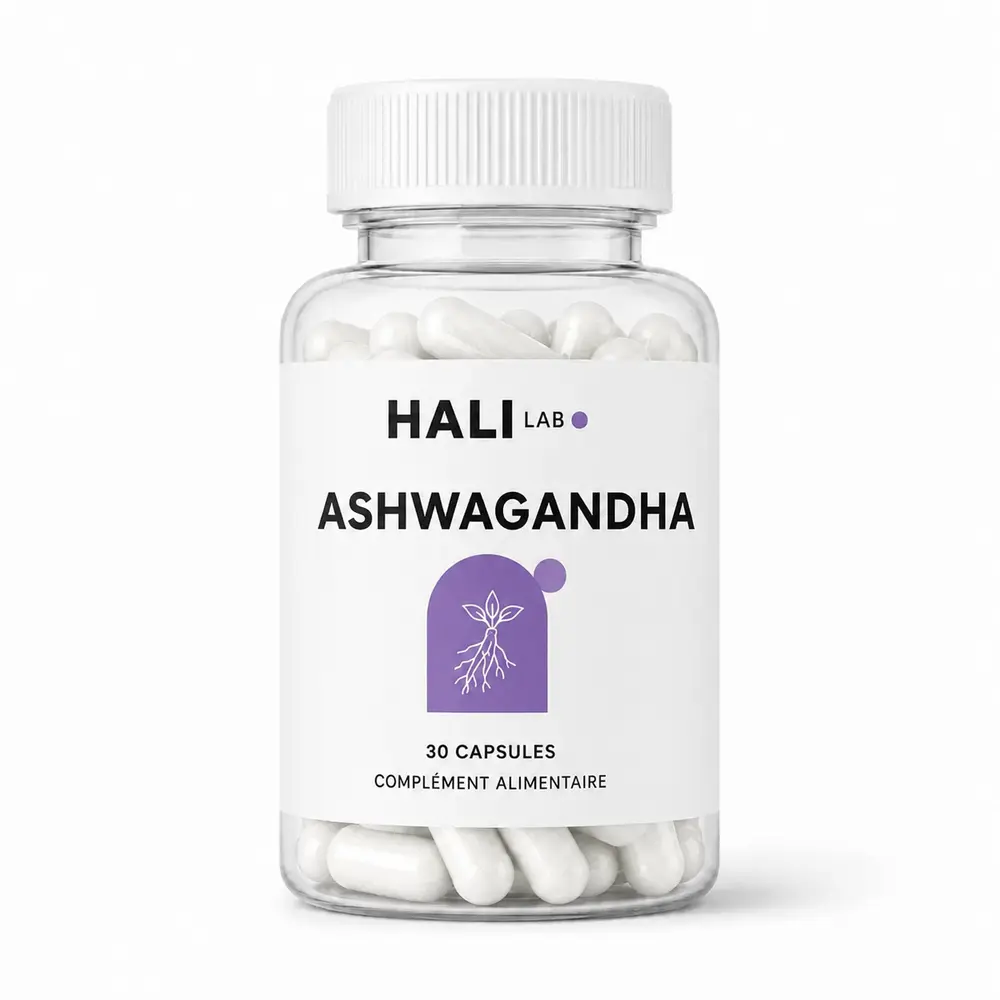
A sales page should not borrow studies of a branded extract when the sold label says only “ashwagandha extract” without that name. If uncertain, request a readable label photo or technical sheet. On our Ashwagandha product page, we describe only the characteristics actually declared and do not assign it an unconfirmed extract brand.
Safety: a brand name does not remove contraindications
According to NCCIH and NIH, ashwagandha appears generally well tolerated in short-term use, up to about three months in available data, but longer-term safety is unknown. Digestive upset, nausea and drowsiness can occur. Rare liver injuries have been reported, and the plant may affect thyroid function.
It is discouraged during pregnancy and breastfeeding, before surgery, and in some autoimmune or thyroid conditions without medical advice. Interactions are possible with sedatives, immunosuppressants, and thyroid, blood-pressure or diabetes medicines. A proprietary name never removes these precautions.
This content is educational and does not replace professional medical advice. Seek medical advice before supplementation if symptoms persist, during pregnancy or breastfeeding, or when taking medication or living with a chronic condition.
How to decide without overinterpreting studies
Start by defining the goal and checking whether more direct care is needed. Then compare complete products, not just three logos: label, serving, evidence matching the exact extract, tolerability, daily cost and seller reliability. If two products are transparent, the more concentrated one is not automatically the more suitable.
The strongest conclusion is a modest one: KSM-66, Sensoril and Shoden have each been studied in certain contexts, but under different protocols. These studies can inform label reading; they justify neither an individual promise, substitution between extracts nor a universal ranking.
Frequently asked questions
Which is stronger, KSM-66 or Sensoril?
No direct trial presented here demonstrates that one is superior. Their plant parts, standardisation and studied doses differ, so comparing only milligrams or percentages is insufficient.
Is 120 mg Shoden weaker than 600 mg KSM-66?
That cannot be inferred. They are different extracts and standardisations evaluated in separate protocols. Mass alone does not measure clinical effect.
Is a root-only extract always better than a root-and-leaf extract?
No. Root-only and root-and-leaf describe different compositions, not an automatic hierarchy. Judge a product by identity, transparency, testing and evidence that precisely matches its preparation.
Can a generic extract claim KSM-66 studies?
Not without demonstrating that it is the same studied ingredient. A similar dose or percentage does not prove equivalence of raw material, process or composition.
How can I verify that a product truly contains a branded extract?
Look for the exact name on the label and consistent manufacturer documentation. Phrases such as “type,” “inspired by” or “equivalent” are insufficient. Request a readable label photo or technical sheet if information remains ambiguous.
Educational content: this is not a diagnosis or prescription and does not replace professional healthcare advice.