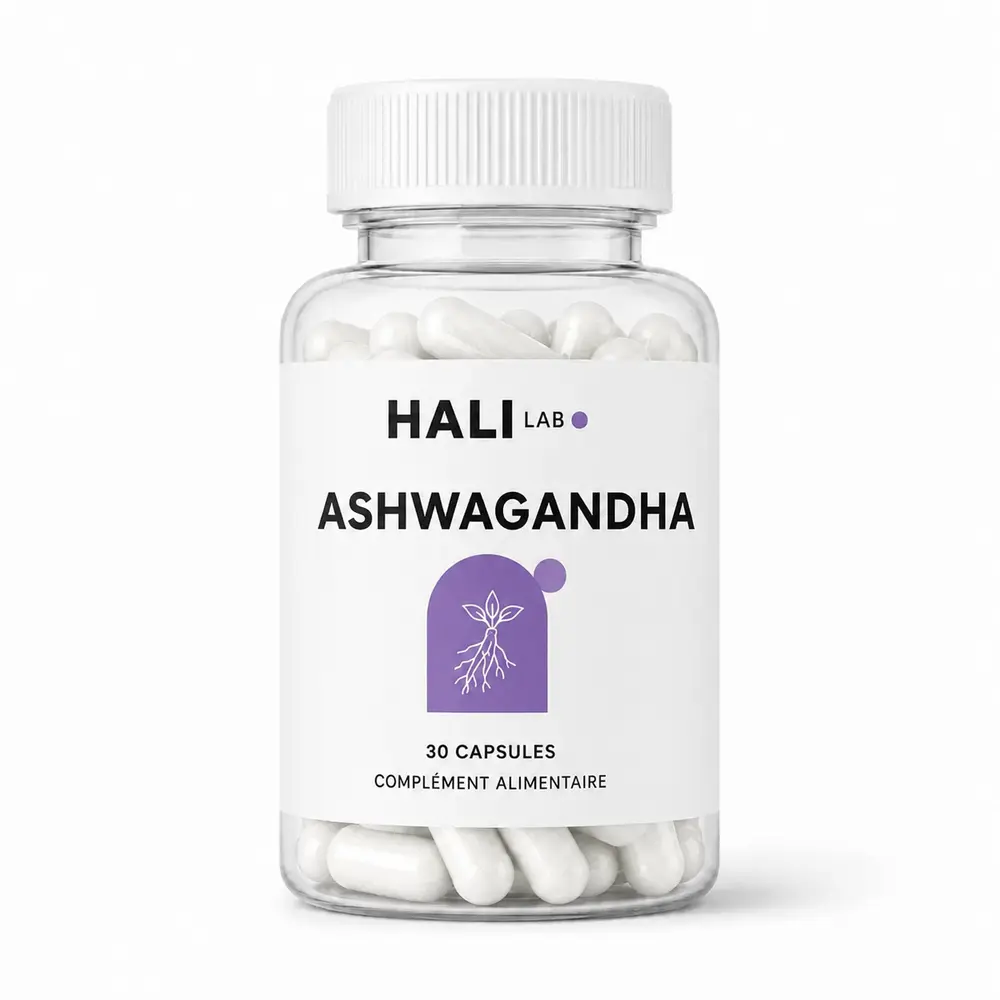
Can ashwagandha support an “underactive” thyroid? The question is common, but the scientific answer is far more cautious than online promises. One small trial measured changes in several thyroid markers in people with subclinical hypothyroidism. It is not enough to establish the herb as a treatment, set a personal dose or replace medical follow-up.
Other publications describe thyrotoxicosis occurring while people were taking ashwagandha, sometimes with palpitations or thyroiditis. These isolated observations cannot estimate how often the risk occurs or prove that every product has the same effect. They nevertheless justify particular caution for people with thyroid disease, autoimmune disease or thyroid-hormone treatment.
Short answer: do not self-treat a thyroid condition with ashwagandha
TSH, free T4 and T3 must be interpreted together, alongside symptoms, medical history and sometimes thyroid antibodies. Fatigue, weight gain or feeling cold do not by themselves prove hypothyroidism. Likewise, palpitations or weight loss have many possible causes. Testing and medical assessment are needed before drawing a conclusion.
NCCIH, part of the US National Institutes of Health, does not recommend ashwagandha for people with thyroid disorders and notes a possible interaction with thyroid-hormone medicines. That precaution matters more than commercial extrapolation from one small study.
What the subclinical hypothyroidism trial actually found
The double-blind randomised trial published in 2018 enrolled 50 adults with elevated TSH below 10 mIU/L. For eight weeks, participants received either 600 mg daily of a standardised root extract or placebo. Compared with baseline and placebo, the ashwagandha group showed changes in TSH, T3 and T4 in the direction of normalised indices.
The trial provides a signal, not definitive clinical proof. It was small, short and studied one specific extract. It did not establish that ashwagandha prevents complications, produces lasting symptom improvement, or is suitable for people with Hashimoto’s thyroiditis, hyperthyroidism, nodules or existing treatment.
Why this result does not turn ashwagandha into a medicine
Subclinical hypothyroidism is not managed in the same way for everyone. Decisions depend on TSH level, age, symptoms, possible pregnancy, antibodies and cardiovascular risk. Management may involve monitoring, further tests or prescribed treatment. A herb cannot replace that individualised decision.
Ashwagandha extracts are not interchangeable: plant part, concentration, withanolide content and quality control can vary. Repeating the milligram amount used in a study with another product therefore guarantees neither the same composition nor the same effect. An experimental dose is not a personal dosing recommendation.
Thyrotoxicosis reports: rare but important to understand
A 2005 report described a 32-year-old woman who developed clinical and laboratory evidence of thyrotoxicosis after increasing her intake of an ashwagandha extract; symptoms and tests normalised after stopping. In 2022, another report described a 73-year-old woman with supraventricular tachycardia and hyperthyroid features after prolonged use, with improvement after discontinuation.
In 2024, clinicians reported painless thyroiditis in a 47-year-old man who had started ashwagandha two months earlier. Imaging and laboratory findings supported the diagnosis, and markers improved after discontinuation. A case report alone does not prove causality or measure incidence, but several consistent observations form a safety signal that should not be ignored.
Hashimoto’s, levothyroxine and other treatment: where is the risk?
Hashimoto’s thyroiditis is an autoimmune disease, and ashwagandha has not been validated as a treatment for it. NCCIH advises against its use in people with autoimmune or thyroid disorders. Adding a supplement that may alter hormone levels can also complicate interpretation of blood tests or treatment adjustments.
Anyone taking levothyroxine, a T4/T3 combination or an antithyroid medicine should not start, stop or change ashwagandha without discussing it with a doctor or pharmacist. Never reduce prescribed medicine because a supplement is marketed as “natural.” Natural does not mean biologically inactive or interaction-free.
Which signs should prompt stopping and seeking care?
New palpitations, a fast or irregular heartbeat, tremor, unusual heat intolerance, excessive sweating, unexplained weight loss, persistent diarrhoea, marked weakness or agitation can be compatible with excess thyroid hormone. They are not specific, but warrant stopping the supplement and seeking prompt medical advice.
Chest pain, severe shortness of breath, fainting, confusion or a very rapid heartbeat require urgent assessment. Bring the container or a clear label photo: the exact name, amount taken, start date and other medicines help the clinician evaluate the situation.
Before buying in Morocco: a simple five-point check
Even without known thyroid disease, check the plant part used, amount per serving, any standardisation, the complete ingredient list and the responsible business. Avoid adverts promising to “cure the thyroid,” replace levothyroxine or normalise TSH without follow-up; those claims go beyond the evidence.
If you already have a diagnosis, abnormal tests, a significant family history or regular treatment, show the label to your doctor or pharmacist before buying. A combination product may also contain other thyroid-relevant ingredients, including iodine, so the whole formula—not only the word ashwagandha—must be assessed.
This content is educational and does not replace professional medical advice. Seek medical advice before supplementation if symptoms persist, during pregnancy or breastfeeding, or when taking medication or living with a chronic condition.
Frequently asked questions
Can ashwagandha lower TSH?
One small eight-week trial observed lower TSH with a specific extract in adults with subclinical hypothyroidism. This isolated finding cannot predict an individual response or support recommending ashwagandha as treatment.
Can ashwagandha be taken with levothyroxine?
NCCIH notes a possible interaction with thyroid-hormone medicines. Ask the doctor or pharmacist managing your treatment before use, and never change the prescribed dose on your own.
Is ashwagandha suitable for Hashimoto’s?
No robust evidence validates it as a treatment for Hashimoto’s. Because this is both an autoimmune and thyroid disorder, NCCIH advises against ashwagandha in this context without professional supervision.
Can ashwagandha cause hyperthyroidism?
A few published cases describe thyrotoxicosis or thyroiditis during use, improving after discontinuation. They cannot determine frequency or prove risk for everyone, but they are an important safety signal.
Should TSH be checked before taking ashwagandha?
Routine screening is not a universal rule. However, symptoms, thyroid history, autoimmune disease, previously abnormal tests or treatment justify medical advice before use.
Educational content: this is not a diagnosis or prescription and does not replace professional healthcare advice.
Sources
- Sharma, Basu et Singh — essai randomisé sur l’hypothyroïdie subclinique (2018)
- Gannon et al. — variations des marqueurs thyroïdiens dans un essai contrôlé (2014)
- van der Hooft et al. — cas de thyrotoxicose (2005)
- Kamal et al. — thyrotoxicose avec tachycardie supraventriculaire (2022)
- Hayashi et al. — cas de thyroïdite indolore (2024)
- NCCIH — Ashwagandha : utilité, sécurité et interactions